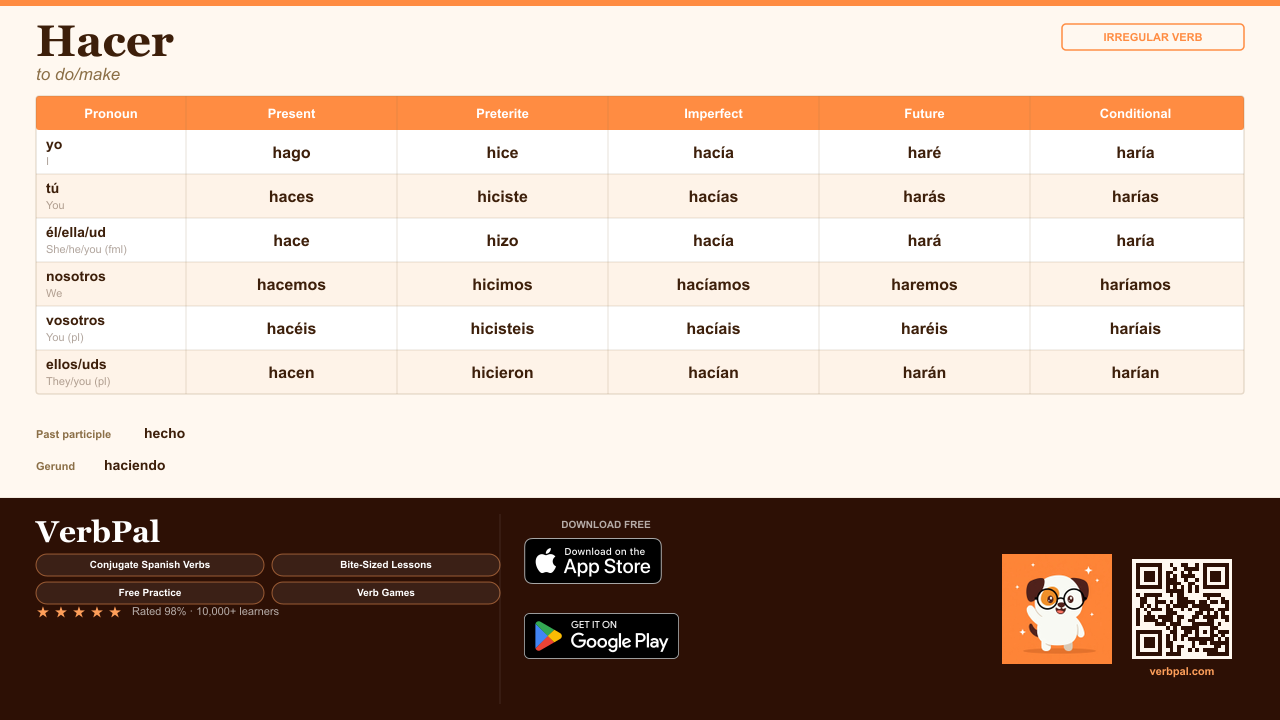
The Spanish verb "hacer" means "to do/make" in English. It is an irregular verb. Below you'll find the complete conjugation tables for "hacer" across all 5 tenses. New to Spanish verbs? Start with the Spanish verb guide.
Jump to a tense

Lexi's Memory Hack
HACER drops the -cer and adds -go in yo: HAGO. Preterite? "HiZo, HiCe" — the z and c swap so it sounds smooth, not "hackay".
Hago → I do/make. In commands: haz (not "hace"). Future/conditional stem: har- (haré, haría).
How to Conjugate "hacer" in the Present Tense
Presente de indicativo Actions happening now or regularly| Person | English | Conjugation |
|---|---|---|
| yo | I | hago |
| tú | you (informal) | haces |
| él/ella/usted | he/she/you (formal) | hace |
| nosotros | we | hacemos |
| vosotros | you all (Spain) | hacéis |
| ellos/ustedes | they/you all | hacen |
Ella hace una torta rica.
say it EH-yah AH-seh
She makes a delicious cake.
In other languages
- French Elle fait un délicieux gâteau.
- German Sie macht einen leckeren Kuchen.
- Dutch Zij maakt een heerlijke taart.
Yo hago mi tarea ahora.
say it YOH AH-goh
I do my homework now.
In other languages
- French Je fais mes devoirs maintenant.
- German Ich mache jetzt meine Hausaufgaben.
- Dutch Ik maak nu mijn huiswerk.
How to Conjugate "hacer" in the Past (completed) Tense
Pretérito perfecto simple Actions that finished in the past| Person | English | Conjugation |
|---|---|---|
| yo | I | hice |
| tú | you (informal) | hiciste |
| él/ella/usted | he/she/you (formal) | hizo |
| nosotros | we | hicimos |
| vosotros | you all (Spain) | hicisteis |
| ellos/ustedes | they/you all | hicieron |
Él hizo ejercicio esta mañana.
say it el EE-so e-ker-SEE-syo ES-ta ma-NYA-na
He did exercise this morning.
In other languages
- French Il a fait de l'exercice ce matin.
- German Er hat heute Morgen Sport gemacht.
- Dutch Hij heeft vanmorgen gesport.
Yo hice la tarea rápidamente.
say it yo EE-seh la ta-REH-ah ra-PEE-da-men-teh
I did the homework quickly.
In other languages
- French J'ai fait les devoirs rapidement.
- German Ich habe die Hausaufgaben schnell gemacht.
- Dutch Ik heb het huiswerk snel gemaakt.
Want to actually remember these?
VerbPal drills "hacer" in real Spanish sentences using spaced repetition.
Try VerbPal FreeHow to Conjugate "hacer" in the Past (ongoing) Tense
Pretérito imperfecto Actions that were ongoing in the past| Person | English | Conjugation |
|---|---|---|
| yo | I | hacía |
| tú | you (informal) | hacías |
| él/ella/usted | he/she/you (formal) | hacía |
| nosotros | we | hacíamos |
| vosotros | you all (Spain) | hacíais |
| ellos/ustedes | they/you all | hacían |
Ella hacía ejercicio diario.
say it EH-yah ah-SEE-ah
She used to do daily exercise.
In other languages
- French Elle avait l'habitude de faire de l'exercice quotidiennement.
- German Sie hat früher täglich Sport gemacht.
- Dutch Zij deed vroeger dagelijks aan lichaamsbeweging.
Yo hacía mi tarea solo.
say it YOH ah-SEE-ah
I used to do my homework alone.
In other languages
- French J'avais l'habitude de faire mes devoirs seul.
- German Ich habe meine Hausaufgaben früher allein gemacht.
- Dutch Ik deed mijn huiswerk vroeger alleen.
How to Conjugate "hacer" in the Future Tense
Futuro simple Actions that will happen| Person | English | Conjugation |
|---|---|---|
| yo | I | haré |
| tú | you (informal) | harás |
| él/ella/usted | he/she/you (formal) | hará |
| nosotros | we | haremos |
| vosotros | you all (Spain) | haréis |
| ellos/ustedes | they/you all | harán |
Él hará ejercicio mañana.
say it ehl ah-RAH
He will exercise tomorrow.
In other languages
- French Il fera de l'exercice demain.
- German Er wird morgen Sport machen.
- Dutch Hij zal morgen sporten.
Yo haré la tarea pronto.
say it yo ah-REH
I will do the homework soon.
In other languages
- French Je ferai les devoirs bientôt.
- German Ich werde die Hausaufgaben bald machen.
- Dutch Ik zal het huiswerk binnenkort doen.
How to Conjugate "hacer" in the Would (conditional) Tense
Condicional simple Hypothetical actions| Person | English | Conjugation |
|---|---|---|
| yo | I | haría |
| tú | you (informal) | harías |
| él/ella/usted | he/she/you (formal) | haría |
| nosotros | we | haríamos |
| vosotros | you all (Spain) | haríais |
| ellos/ustedes | they/you all | harían |
Él haría ejercicio diario.
say it el ah-REE-ah
He would do daily exercise.
In other languages
- French Il ferait de l'exercice quotidiennement.
- German Er würde täglich Sport machen.
- Dutch Hij zou dagelijks aan lichaamsbeweging doen.
Yo haría mi tarea pronto.
say it yo ah-REE-ah
I would do my homework soon.
In other languages
- French Je ferais mes devoirs bientôt.
- German Ich würde bald meine Hausaufgaben machen.
- Dutch Ik zou binnenkort mijn huiswerk doen.
Frequently Asked Questions About "hacer"
Is "hacer" regular or irregular in Spanish?
"Hacer" is an irregular Spanish verb, meaning its conjugation does not follow standard patterns and must be memorized individually.
What does "hacer" mean in English?
The Spanish verb "hacer" means "to do/make" in English.
How do you conjugate "hacer" in the present tense?
In the present tense (Presente de indicativo): yo → hago, tú → haces, él/ella/usted → hace, nosotros → hacemos, vosotros → hacéis, ellos/ustedes → hacen.
How many tenses does "hacer" have in Spanish?
"Hacer" is conjugated across 5 tenses in Spanish: Present, Past (completed), Past (ongoing), Future, Would (conditional).
Master Spanish verbs for real
Stop memorizing tables. Start speaking with confidence.
Try VerbPal Free3-day free trial. Cancel anytime.