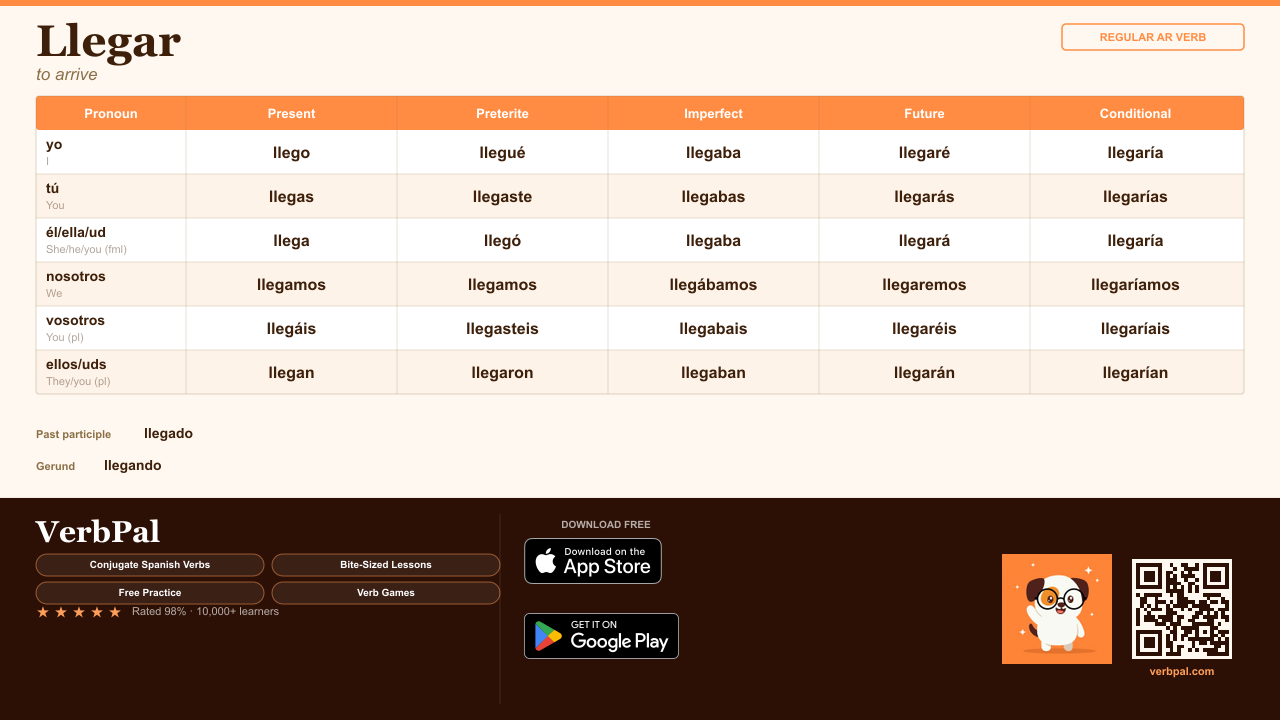
The Spanish verb "llegar" means "to arrive" in English. It is a regular verb. Below you'll find the complete conjugation tables for "llegar" across all 5 tenses. New to Spanish verbs? Start with the Spanish verb guide.
Jump to a tense
How to Conjugate "llegar" in the Present Tense
Presente de indicativo Actions happening now or regularly| Person | English | Conjugation |
|---|---|---|
| yo | I | llego |
| tú | you (informal) | llegas |
| él/ella/usted | he/she/you (formal) | llega |
| nosotros | we | llegamos |
| vosotros | you all (Spain) | llegáis |
| ellos/ustedes | they/you all | llegan |
Ella llega al trabajo a tiempo.
say it EH-yah YEH-gah
She arrives at work on time.
In other languages
- French Elle arrive au travail à l'heure.
- German Sie kommt pünktlich zur Arbeit.
- Dutch Zij komt op tijd op het werk aan.
Yo llego a casa muy cansado.
say it YOH YEH-goh
I arrive home very tired.
In other languages
- French J'arrive à la maison très fatigué.
- German Ich komme sehr müde nach Hause.
- Dutch Ik kom heel moe thuis.
How to Conjugate "llegar" in the Past (completed) Tense
Pretérito perfecto simple Actions that finished in the past| Person | English | Conjugation |
|---|---|---|
| yo | I | llegué |
| tú | you (informal) | llegaste |
| él/ella/usted | he/she/you (formal) | llegó |
| nosotros | we | llegamos |
| vosotros | you all (Spain) | llegasteis |
| ellos/ustedes | they/you all | llegaron |
Él llegó al aeropuerto a tiempo.
say it yeh-GOH
He arrived at the airport on time.
In other languages
- French Il est arrivé à l'aéroport à l'heure.
- German Er kam pünktlich am Flughafen an.
- Dutch Hij kwam op tijd op het vliegveld aan.
Yo llegué tarde a la reunión.
say it yeh-GEH
I arrived late to the meeting.
In other languages
- French Je suis arrivé en retard à la réunion.
- German Ich kam zu spät zum Treffen.
- Dutch Ik kwam te laat op de vergadering.
Want to actually remember these?
VerbPal drills "llegar" in real Spanish sentences using spaced repetition.
Try VerbPal FreeHow to Conjugate "llegar" in the Past (ongoing) Tense
Pretérito imperfecto Actions that were ongoing in the past| Person | English | Conjugation |
|---|---|---|
| yo | I | llegaba |
| tú | you (informal) | llegabas |
| él/ella/usted | he/she/you (formal) | llegaba |
| nosotros | we | llegábamos |
| vosotros | you all (Spain) | llegabais |
| ellos/ustedes | they/you all | llegaban |
Él llegaba temprano al trabajo.
say it EHL yeh-GAH-bah
He used to arrive early to work.
In other languages
- French Il avait l'habitude d'arriver tôt au travail.
- German Er kam früher oft früh zur Arbeit.
- Dutch Hij kwam vroeger vaak vroeg op het werk aan.
Yo llegaba tarde a la escuela.
say it YOH yeh-GAH-bah
I used to arrive late to school.
In other languages
- French J'avais l'habitude d'arriver en retard à l'école.
- German Ich kam früher oft zu spät zur Schule.
- Dutch Ik kwam vroeger vaak te laat op school.
How to Conjugate "llegar" in the Future Tense
Futuro simple Actions that will happen| Person | English | Conjugation |
|---|---|---|
| yo | I | llegaré |
| tú | you (informal) | llegarás |
| él/ella/usted | he/she/you (formal) | llegará |
| nosotros | we | llegaremos |
| vosotros | you all (Spain) | llegaréis |
| ellos/ustedes | they/you all | llegarán |
Él llegará a la meta.
say it ehl yeh-gah-RAH
He will arrive at the goal.
In other languages
- French Il arrivera à l'arrivée.
- German Er wird am Ziel ankommen.
- Dutch Hij zal bij de finish aankomen.
Yo llegaré a las ocho.
say it yo yeh-gah-REH
I will arrive at eight.
In other languages
- French J'arriverai à huit heures.
- German Ich werde um acht Uhr ankommen.
- Dutch Ik zal om acht uur aankomen.
How to Conjugate "llegar" in the Would (conditional) Tense
Condicional simple Hypothetical actions| Person | English | Conjugation |
|---|---|---|
| yo | I | llegaría |
| tú | you (informal) | llegarías |
| él/ella/usted | he/she/you (formal) | llegaría |
| nosotros | we | llegaríamos |
| vosotros | you all (Spain) | llegaríais |
| ellos/ustedes | they/you all | llegarían |
Él llegaría a casa muy cansado.
say it ehl yeh-GAH-ree-ah
He would arrive home very tired.
In other languages
- French Il arriverait à la maison très fatigué.
- German Er würde sehr müde nach Hause kommen.
- Dutch Hij zou heel moe thuiskomen.
Yo llegaría a tiempo si corro.
say it yo yeh-GAH-ree-ah
I would arrive on time if I run.
In other languages
- French J'arriverais à l'heure si je cours.
- German Ich würde pünktlich ankommen, wenn ich renne.
- Dutch Ik zou op tijd aankomen als ik ren.
Frequently Asked Questions About "llegar"
Is "llegar" regular or irregular in Spanish?
"Llegar" is a regular Spanish verb that follows standard conjugation patterns for its verb group.
What does "llegar" mean in English?
The Spanish verb "llegar" means "to arrive" in English.
How do you conjugate "llegar" in the present tense?
In the present tense (Presente de indicativo): yo → llego, tú → llegas, él/ella/usted → llega, nosotros → llegamos, vosotros → llegáis, ellos/ustedes → llegan.
How many tenses does "llegar" have in Spanish?
"Llegar" is conjugated across 5 tenses in Spanish: Present, Past (completed), Past (ongoing), Future, Would (conditional).
Master Spanish verbs for real
Stop memorizing tables. Start speaking with confidence.
Try VerbPal Free3-day free trial. Cancel anytime.