The Spanish verb "madrugar" means "to get up early" in English. It is a regular verb. Below you'll find the complete conjugation tables for "madrugar" across all 5 tenses. New to Spanish verbs? Start with the Spanish verb guide.
Jump to a tense
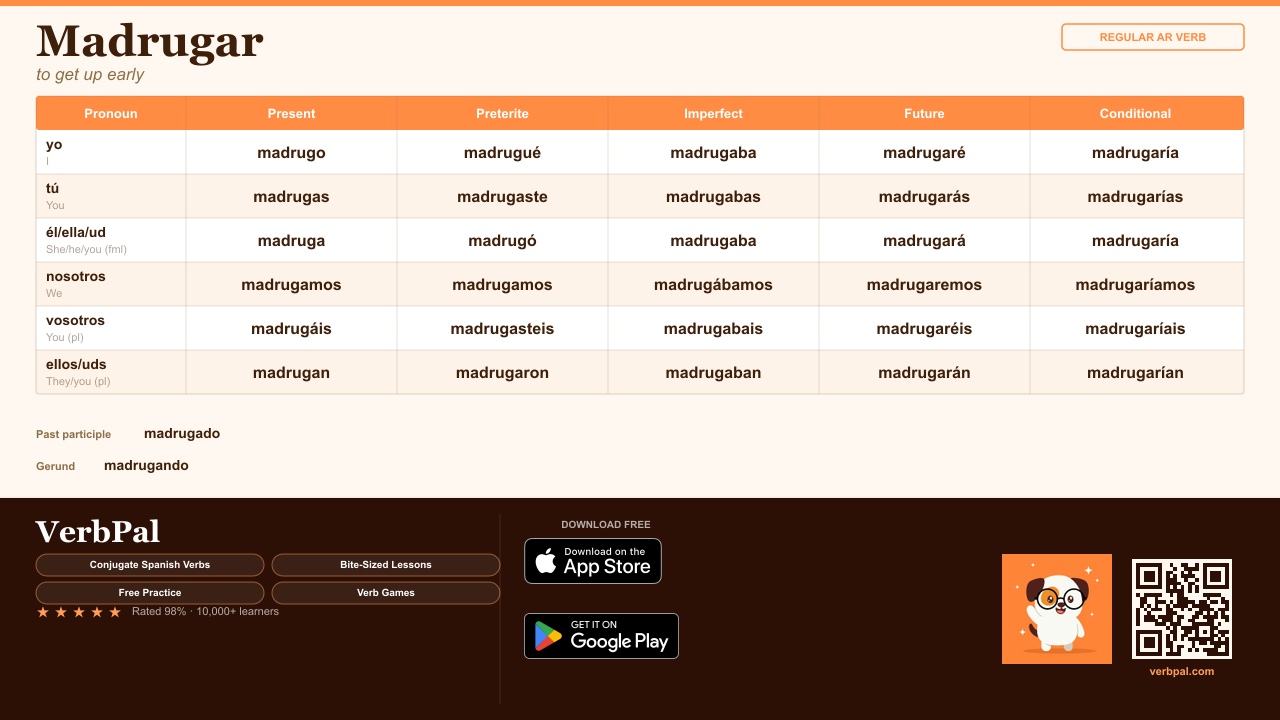
How to Conjugate "madrugar" in the Present Tense
Presente de indicativo Actions happening now or regularly| Person | English | Conjugation |
|---|---|---|
| yo | I | madrugo |
| tú | you (informal) | madrugas |
| él/ella/usted | he/she/you (formal) | madruga |
| nosotros | we | madrugamos |
| vosotros | you all (Spain) | madrugáis |
| ellos/ustedes | they/you all | madrugan |
Él madruga mucho hoy.
say it el mah-DROO-gah MOO-choh oy
He gets up early today.
In other languages
- French Il se lève tôt aujourd'hui.
- German Er steht heute früh auf.
- Dutch Hij staat vandaag vroeg op.
Yo madrugo todos los días.
say it yo mah-DROO-goh TOH-dos los DEE-ahs
I get up early every day.
In other languages
- French Je me lève tôt tous les jours.
- German Ich stehe jeden Tag früh auf.
- Dutch Ik sta elke dag vroeg op.
How to Conjugate "madrugar" in the Past (completed) Tense
Pretérito perfecto simple Actions that finished in the past| Person | English | Conjugation |
|---|---|---|
| yo | I | madrugué |
| tú | you (informal) | madrugaste |
| él/ella/usted | he/she/you (formal) | madrugó |
| nosotros | we | madrugamos |
| vosotros | you all (Spain) | madrugasteis |
| ellos/ustedes | they/you all | madrugaron |
Ella madrugó para la escuela.
say it EH-yah mah-droo-GOH pah-rah lah ehs-KWEH-lah
She got up early for school.
In other languages
- French Elle s'est levée tôt pour aller à l'école.
- German Sie ist früh aufgestanden, um zur Schule zu gehen.
- Dutch Zij is vroeg opgestaan om naar school te gaan.
Yo madrugué hoy.
say it yo mah-droo-GAI oy
I got up early today.
In other languages
- French Je me suis levé tôt aujourd'hui.
- German Ich bin heute früh aufgestanden.
- Dutch Ik ben vandaag vroeg opgestaan.
Want to actually remember these?
VerbPal drills "madrugar" in real Spanish sentences using spaced repetition.
Try VerbPal FreeHow to Conjugate "madrugar" in the Past (ongoing) Tense
Pretérito imperfecto Actions that were ongoing in the past| Person | English | Conjugation |
|---|---|---|
| yo | I | madrugaba |
| tú | you (informal) | madrugabas |
| él/ella/usted | he/she/you (formal) | madrugaba |
| nosotros | we | madrugábamos |
| vosotros | you all (Spain) | madrugabais |
| ellos/ustedes | they/you all | madrugaban |
Él madrugaba para trabajar.
say it el mah-droo-GA-ba PAH-rah trah-bah-HAR
He used to get up early to work.
In other languages
- French Il se levait tôt pour travailler.
- German Er stand früher früh auf, um zu arbeiten.
- Dutch Hij stond vroeger vroeg op om te werken.
Yo madrugaba todos los días.
say it yo mah-droo-GA-ba TOH-dos lohs DEE-as
I used to get up early every day.
In other languages
- French Je me levais tôt tous les jours.
- German Ich stand früher jeden Tag früh auf.
- Dutch Ik stond vroeger elke dag vroeg op.
How to Conjugate "madrugar" in the Future Tense
Futuro simple Actions that will happen| Person | English | Conjugation |
|---|---|---|
| yo | I | madrugaré |
| tú | you (informal) | madrugarás |
| él/ella/usted | he/she/you (formal) | madrugará |
| nosotros | we | madrugaremos |
| vosotros | you all (Spain) | madrugaréis |
| ellos/ustedes | they/you all | madrugarán |
Él madrugará para trabajar.
say it el mah-droo-gah-RÁ PAH-rah trah-bah-HAR
He will get up early to work.
In other languages
- French Il se lèvera tôt pour travailler.
- German Er wird früh aufstehen, um zu arbeiten.
- Dutch Hij zal vroeg opstaan om te werken.
Yo madrugaré mañana.
say it yo mah-droo-gah-RÉ mah-NYAH-nah
I will get up early tomorrow.
In other languages
- French Je me lèverai tôt demain.
- German Ich werde morgen früh aufstehen.
- Dutch Ik zal morgen vroeg opstaan.
How to Conjugate "madrugar" in the Would (conditional) Tense
Condicional simple Hypothetical actions| Person | English | Conjugation |
|---|---|---|
| yo | I | madrugaría |
| tú | you (informal) | madrugarías |
| él/ella/usted | he/she/you (formal) | madrugaría |
| nosotros | we | madrugaríamos |
| vosotros | you all (Spain) | madrugaríais |
| ellos/ustedes | they/you all | madrugarían |
Él madrugaría todos los días.
say it el mah-droo-gah-REE-ah TOH-dohs lohs DEE-ahs
He would get up early every day.
In other languages
- French Il se lèverait tôt tous les jours.
- German Er würde jeden Tag früh aufstehen.
- Dutch Hij zou elke dag vroeg opstaan.
Yo madrugaría mañana.
say it yo mah-droo-gah-REE-ah mah-NYAH-nah
I would get up early tomorrow.
In other languages
- French Je me lèverais tôt demain.
- German Ich würde morgen früh aufstehen.
- Dutch Ik zou morgen vroeg opstaan.
Frequently Asked Questions About "madrugar"
Is "madrugar" regular or irregular in Spanish?
"Madrugar" is a regular Spanish verb that follows standard conjugation patterns for its verb group.
What does "madrugar" mean in English?
The Spanish verb "madrugar" means "to get up early" in English.
How do you conjugate "madrugar" in the present tense?
In the present tense (Presente de indicativo): yo → madrugo, tú → madrugas, él/ella/usted → madruga, nosotros → madrugamos, vosotros → madrugáis, ellos/ustedes → madrugan.
How many tenses does "madrugar" have in Spanish?
"Madrugar" is conjugated across 5 tenses in Spanish: Present, Past (completed), Past (ongoing), Future, Would (conditional).
Master Spanish verbs for real
Stop memorizing tables. Start speaking with confidence.
Try VerbPal Free3-day free trial. Cancel anytime.