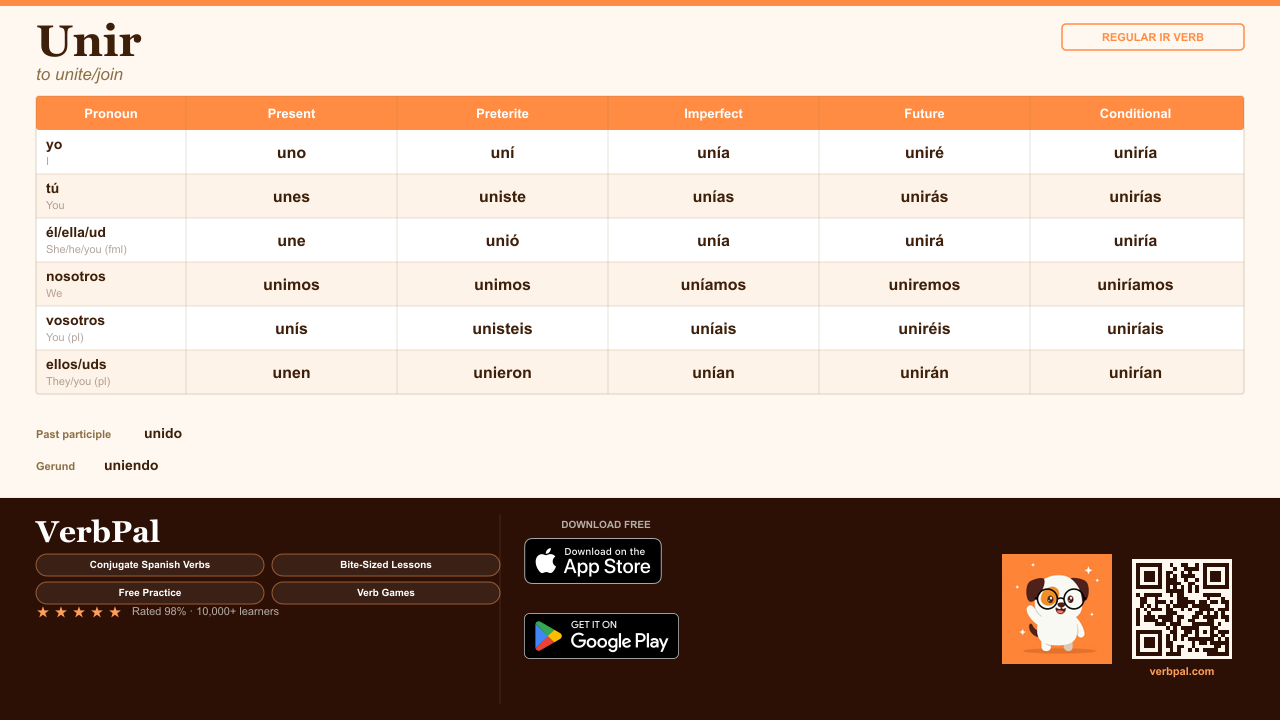
The Spanish verb "unir" means "to unite/join" in English. It is a regular verb. Below you'll find the complete conjugation tables for "unir" across all 5 tenses. New to Spanish verbs? Start with the Spanish verb guide.
Jump to a tense
How to Conjugate "unir" in the Present Tense
Presente de indicativo Actions happening now or regularly| Person | English | Conjugation |
|---|---|---|
| yo | I | uno |
| tú | you (informal) | unes |
| él/ella/usted | he/she/you (formal) | une |
| nosotros | we | unimos |
| vosotros | you all (Spain) | unís |
| ellos/ustedes | they/you all | unen |
Ella une a la familia.
say it EH-yah OO-neh ah lah fah-MEE-lyah
She unites the family.
In other languages
- French Elle unit la famille.
- German Sie vereint die Familie.
- Dutch Zij verenigt de familie.
Yo uno las piezas.
say it yo OO-noh las PYEH-sahs
I join the pieces.
In other languages
- French Je joins les pièces.
- German Ich füge die Teile zusammen.
- Dutch Ik voeg de stukken samen.
How to Conjugate "unir" in the Past (completed) Tense
Pretérito perfecto simple Actions that finished in the past| Person | English | Conjugation |
|---|---|---|
| yo | I | uní |
| tú | you (informal) | uniste |
| él/ella/usted | he/she/you (formal) | unió |
| nosotros | we | unimos |
| vosotros | you all (Spain) | unisteis |
| ellos/ustedes | they/you all | unieron |
Ella unió las manos.
say it EH-yah oo-NYOH las MAH-nos
She joined hands.
In other languages
- French Elle s'est donné la main.
- German Sie hat Hände gefasst.
- Dutch Zij heeft de handen ineengeslagen.
Yo uní las piezas.
say it yo oo-NEE las PYEH-sas
I joined the pieces.
In other languages
- French J'ai joint les pièces.
- German Ich habe die Teile zusammengefügt.
- Dutch Ik heb de stukken samengevoegd.
Want to actually remember these?
VerbPal drills "unir" in real Spanish sentences using spaced repetition.
Try VerbPal FreeHow to Conjugate "unir" in the Past (ongoing) Tense
Pretérito imperfecto Actions that were ongoing in the past| Person | English | Conjugation |
|---|---|---|
| yo | I | unía |
| tú | you (informal) | unías |
| él/ella/usted | he/she/you (formal) | unía |
| nosotros | we | uníamos |
| vosotros | you all (Spain) | uníais |
| ellos/ustedes | they/you all | unían |
Ella unía a los niños.
say it EH-yah oo-NEE-ah ah lohs NEE-nyohs
She was bringing the children together.
In other languages
- French Elle réunissait les enfants.
- German Sie brachte die Kinder zusammen.
- Dutch Zij bracht de kinderen samen.
Yo unía dos piezas.
say it yo oo-NEE-ah dohs PYEH-sahs
I was joining two pieces.
In other languages
- French J'étais en train de joindre deux pièces.
- German Ich fügte zwei Teile zusammen.
- Dutch Ik was twee stukken aan het samenvoegen.
How to Conjugate "unir" in the Future Tense
Futuro simple Actions that will happen| Person | English | Conjugation |
|---|---|---|
| yo | I | uniré |
| tú | you (informal) | unirás |
| él/ella/usted | he/she/you (formal) | unirá |
| nosotros | we | uniremos |
| vosotros | you all (Spain) | uniréis |
| ellos/ustedes | they/you all | unirán |
Él unirá a la familia.
say it el oo-nee-RÁ ah lah fah-MEE-lyah
He will unite the family.
In other languages
- French Il va unir la famille.
- German Er wird die Familie vereinen.
- Dutch Hij zal de familie verenigen.
Yo uniré las piezas.
say it yo oo-NEE-RÉ las PYEH-sahs
I will join the pieces.
In other languages
- French Je vais assembler les pièces.
- German Ich werde die Teile zusammenfügen.
- Dutch Ik zal de stukken samenvoegen.
How to Conjugate "unir" in the Would (conditional) Tense
Condicional simple Hypothetical actions| Person | English | Conjugation |
|---|---|---|
| yo | I | uniría |
| tú | you (informal) | unirías |
| él/ella/usted | he/she/you (formal) | uniría |
| nosotros | we | uniríamos |
| vosotros | you all (Spain) | uniríais |
| ellos/ustedes | they/you all | unirían |
Él uniría las familias.
say it el oo-NEE-REE-AH
He would unite the families.
In other languages
- French Il unirait les familles.
- German Er würde die Familien vereinen.
- Dutch Hij zou de families verenigen.
Yo uniría las dos partes.
say it yo oo-NEE-REE-AH
I would join the two parts.
In other languages
- French Je réunirais les deux parties.
- German Ich würde die beiden Teile zusammenfügen.
- Dutch Ik zou de twee delen samenvoegen.
Frequently Asked Questions About "unir"
Is "unir" regular or irregular in Spanish?
"Unir" is a regular Spanish verb that follows standard conjugation patterns for its verb group.
What does "unir" mean in English?
The Spanish verb "unir" means "to unite/join" in English.
How do you conjugate "unir" in the present tense?
In the present tense (Presente de indicativo): yo → uno, tú → unes, él/ella/usted → une, nosotros → unimos, vosotros → unís, ellos/ustedes → unen.
How many tenses does "unir" have in Spanish?
"Unir" is conjugated across 5 tenses in Spanish: Present, Past (completed), Past (ongoing), Future, Would (conditional).
Master Spanish verbs for real
Stop memorizing tables. Start speaking with confidence.
Try VerbPal Free3-day free trial. Cancel anytime.