The Spanish verb "existir" means "to exist" in English. It is a regular verb. Below you'll find the complete conjugation tables for "existir" across all 5 tenses. New to Spanish verbs? Start with the Spanish verb guide.
Jump to a tense
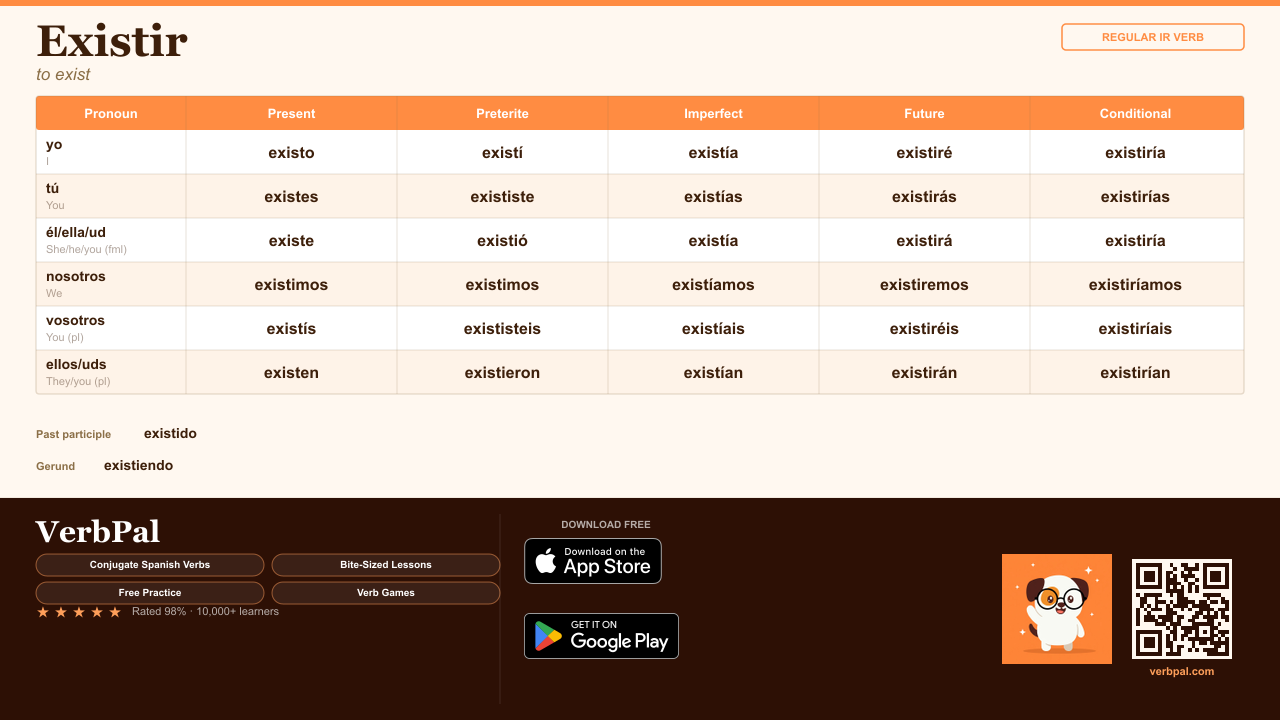
How to Conjugate "existir" in the Present Tense
Presente de indicativo Actions happening now or regularly| Person | English | Conjugation |
|---|---|---|
| yo | I | existo |
| tú | you (informal) | existes |
| él/ella/usted | he/she/you (formal) | existe |
| nosotros | we | existimos |
| vosotros | you all (Spain) | existís |
| ellos/ustedes | they/you all | existen |
Él existe en mis recuerdos.
say it eg-SIS-teh
He exists in my memories.
In other languages
- French Il existe dans mes souvenirs.
- German Er existiert in meinen Erinnerungen.
- Dutch Hij bestaat in mijn herinneringen.
Yo existo en este mundo.
say it eg-SIS-toh
I exist in this world.
In other languages
- French J'existe dans ce monde.
- German Ich existiere in dieser Welt.
- Dutch Ik besta in deze wereld.
How to Conjugate "existir" in the Past (completed) Tense
Pretérito perfecto simple Actions that finished in the past| Person | English | Conjugation |
|---|---|---|
| yo | I | existí |
| tú | you (informal) | exististe |
| él/ella/usted | he/she/you (formal) | existió |
| nosotros | we | existimos |
| vosotros | you all (Spain) | exististeis |
| ellos/ustedes | they/you all | existieron |
Él existió antes de la guerra.
say it ek-sees-TYOH
He existed before the war.
In other languages
- French Il existait avant la guerre.
- German Er existierte vor dem Krieg.
- Dutch Hij bestond vóór de oorlog.
Yo existí en otro tiempo.
say it ek-sees-TEE
I existed in another time.
In other languages
- French J'existais à une autre époque.
- German Ich existierte in einer anderen Zeit.
- Dutch Ik bestond in een andere tijd.
Want to actually remember these?
VerbPal drills "existir" in real Spanish sentences using spaced repetition.
Try VerbPal FreeHow to Conjugate "existir" in the Past (ongoing) Tense
Pretérito imperfecto Actions that were ongoing in the past| Person | English | Conjugation |
|---|---|---|
| yo | I | existía |
| tú | you (informal) | existías |
| él/ella/usted | he/she/you (formal) | existía |
| nosotros | we | existíamos |
| vosotros | you all (Spain) | existíais |
| ellos/ustedes | they/you all | existían |
Existía mucha paz en ese pueblo.
say it eg-sis-TEE-ah
There used to be a lot of peace in that town.
In other languages
- French Il y avait autrefois beaucoup de paix dans cette ville.
- German Es gab früher viel Frieden in dieser Stadt.
- Dutch Er was vroeger veel vrede in die stad.
Yo pensaba que existía la magia.
say it eg-sis-TEE-ah
I used to think that magic existed.
In other languages
- French Je pensais autrefois que la magie existait.
- German Ich dachte früher, dass Magie existierte.
- Dutch Ik dacht vroeger dat magie bestond.
How to Conjugate "existir" in the Future Tense
Futuro simple Actions that will happen| Person | English | Conjugation |
|---|---|---|
| yo | I | existiré |
| tú | you (informal) | existirás |
| él/ella/usted | he/she/you (formal) | existirá |
| nosotros | we | existiremos |
| vosotros | you all (Spain) | existiréis |
| ellos/ustedes | they/you all | existirán |
Él existirá en la historia.
say it ek-sis-tee-RAH
He will exist in history.
In other languages
- French Il existera dans l'histoire.
- German Er wird in der Geschichte existieren.
- Dutch Hij zal in de geschiedenis bestaan.
Yo existiré por siempre mañana.
say it ek-sis-tee-REH
I will exist forever tomorrow.
In other languages
- French J'existerai pour toujours demain.
- German Ich werde morgen für immer existieren.
- Dutch Ik zal morgen voor altijd bestaan.
How to Conjugate "existir" in the Would (conditional) Tense
Condicional simple Hypothetical actions| Person | English | Conjugation |
|---|---|---|
| yo | I | existiría |
| tú | you (informal) | existirías |
| él/ella/usted | he/she/you (formal) | existiría |
| nosotros | we | existiríamos |
| vosotros | you all (Spain) | existiríais |
| ellos/ustedes | they/you all | existirían |
Él pensaría que existiría paz.
say it eg-sis-TEE-ree-ah
He would think that peace would exist.
In other languages
- French Il penserait que la paix existerait.
- German Er würde denken, dass Frieden existieren würde.
- Dutch Hij zou denken dat vrede zou bestaan.
Yo creería que existiría otra forma.
say it eg-sis-TEE-ree-ah
I would believe another way would exist.
In other languages
- French Je croirais qu'une autre manière existerait.
- German Ich würde glauben, dass ein anderer Weg existieren würde.
- Dutch Ik zou geloven dat er een andere manier zou bestaan.
Frequently Asked Questions About "existir"
Is "existir" regular or irregular in Spanish?
"Existir" is a regular Spanish verb that follows standard conjugation patterns for its verb group.
What does "existir" mean in English?
The Spanish verb "existir" means "to exist" in English.
How do you conjugate "existir" in the present tense?
In the present tense (Presente de indicativo): yo → existo, tú → existes, él/ella/usted → existe, nosotros → existimos, vosotros → existís, ellos/ustedes → existen.
How many tenses does "existir" have in Spanish?
"Existir" is conjugated across 5 tenses in Spanish: Present, Past (completed), Past (ongoing), Future, Would (conditional).
Master Spanish verbs for real
Stop memorizing tables. Start speaking with confidence.
Try VerbPal Free3-day free trial. Cancel anytime.